How Spelling Bee scoring works
By the Spelling Bee Game team
How points are scored
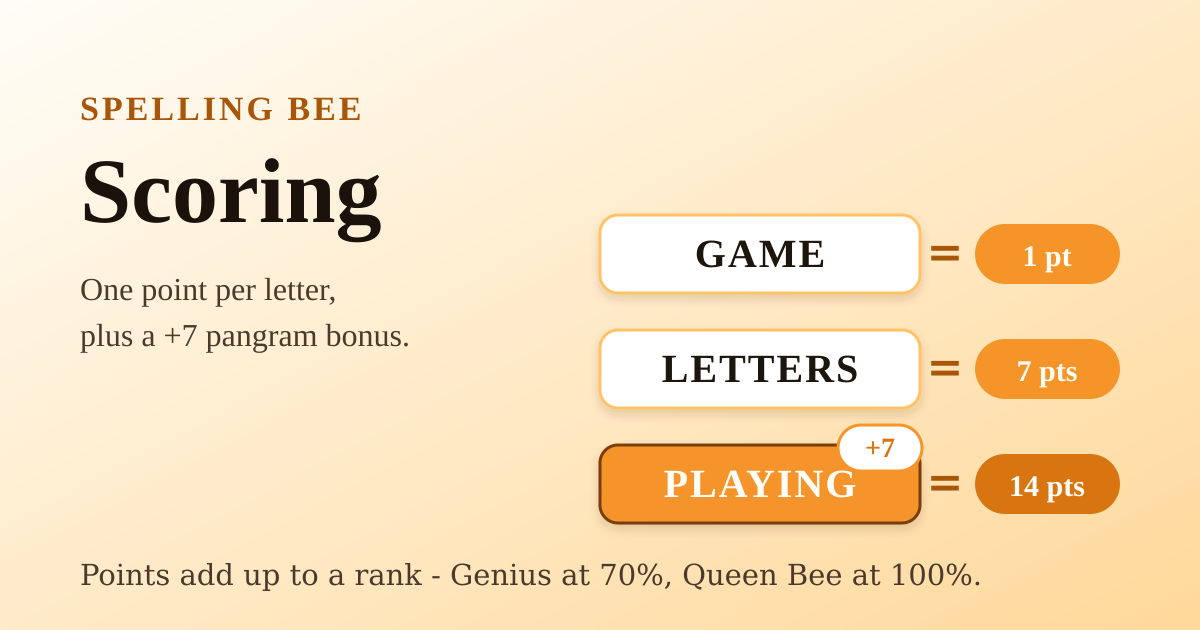
Scoring in the Spelling Bee Game is based almost entirely on word length. A four-letter word - the shortest word the game accepts - is worth 1 point. Every word longer than that scores one point for each letter it contains, so a five-letter word is worth 5 points, a six-letter word is worth 6, and so on.
That single rule has a big consequence: longer words are worth far more than short ones. A single eight-letter word scores 8 points, the same as eight separate four-letter words. When you want to climb the rank ladder quickly, hunting for the longest words on the board is the most efficient use of your time.
Letters can be reused as often as you like, and reused letters still count toward length. A word like LEVEL or SETTEE scores for its full length even though it repeats letters, so doubled-letter words are an easy way to rack up points.
The pangram bonus
On top of the length score, every pangram earns a flat bonus of 7 points. A pangram is a word that uses all seven letters of the puzzle at least once, and there is always at least one in every board.
The bonus stacks with the normal length score, which makes pangrams the highest-value play in the game. A seven-letter pangram scores 7 points for its length plus the 7-point bonus, for 14 points in total - and a longer pangram is worth even more. Because of this, finding the pangram early is almost always the fastest way to move the score bar.
How points become ranks
Your score is not measured against a fixed number. Instead, the game adds up every valid word on the board to get the maximum possible score, and your rank is the share of that maximum you have reached. This means the same point total can be a different rank on different puzzles, depending on how many words the board holds.
The ladder runs from Beginner up through Good, Nice, Great and Amazing, then Genius at 70% of the total points, and finally Queen Bee at 100%. Because Genius arrives at 70%, you can earn the headline rank without finding every word - but the last stretch to Queen Bee means tracking down every remaining point, including all the pangram bonuses.
How to score the most points
Three habits move your score the fastest. First, find the pangrams: each one is worth a length score plus the 7-point bonus, so they are the single biggest swing available. Second, favour long words over short ones, since points scale directly with length. Third, build volume by cycling through common prefixes and suffixes - re-, un- and pre- on the front, and -ing, -ed, -er and -ly on the back - to turn one valid root into several scoring words.
Put together, these add up quickly. Lock in the pangram bonuses, stretch every word as long as the letters allow, and grind the easy variations, and the climb from Genius to Queen Bee becomes a matter of method rather than luck.
Frequently asked questions
How many points is a four-letter word worth?
A four-letter word is worth 1 point. It is the shortest word the Spelling Bee Game accepts, and every word must be at least four letters long.
How are longer words scored?
Words of five letters or more score one point per letter. A five-letter word is worth 5 points, a six-letter word 6 points, and so on - so longer words are always more valuable.
How much is the pangram bonus?
Every pangram adds a flat 7-point bonus on top of its length score. A seven-letter pangram is therefore worth 14 points in total.
What score do you need to reach Genius or Queen Bee?
Ranks are based on the share of the puzzle's total points you have earned. Genius is reached at 70% of the maximum, and Queen Bee requires 100% - every word, including all pangrams.
Related pages
What is a pangram?
A pangram uses all seven letters at least once - and it is worth a big bonus. Here is how to spot them.
How to reach Queen Bee
Genius is great, but Queen Bee means everything. Here is how to find the last stubborn words.
Prefixes and suffixes that unlock more words
Most missing words are just endings you have not tried. This is the cheat sheet.