Prefixes and suffixes that unlock more words
By the Spelling Bee Game team
Why endings do the heavy lifting
When players get stuck, the words they are missing are rarely strange or obscure. They are usually ordinary words with endings that simply were not tried. Treating prefixes and suffixes as a checklist is the fastest way to turn one valid root into five or six more words.
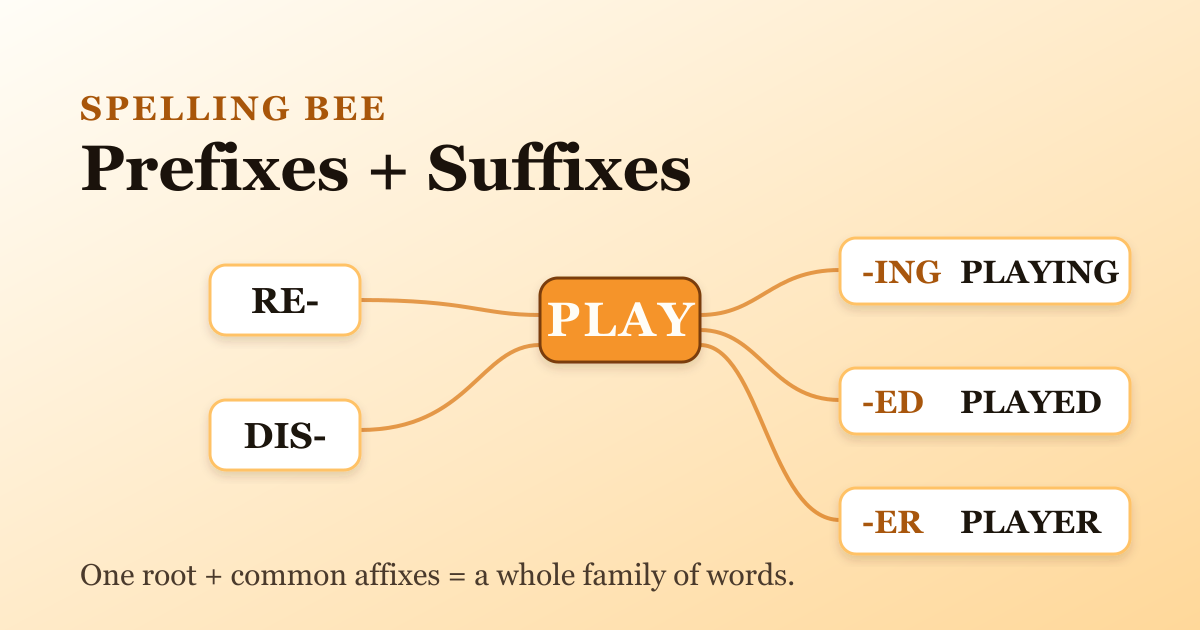
Take the root PLAY. With common affixes it becomes PLAYING, PLAYED, PLAYER and REPLAY - four extra words from a single base. The same pattern repeats across almost every board.
Suffixes do the most work
The four most productive suffixes are -ing, -ed, -er and -ly. Whenever a base word is valid, test each of these endings, because the letters on the board often allow more than one. On harder puzzles, also try -ion, -tion, -ment and -ness, which tend to appear when the board has the right consonant mix.
Suffixes are also where pangrams hide. The endings -ing and -ation use several letters at once, so a pangram very often finishes with one of them.
Prefixes multiply your finds
If the center letter sits inside a common prefix, you can unlock a dozen words at once. The most useful prefixes in the Spelling Bee Game are re-, un-, pre-, out-, over- and under-. Scan the board for these first, because each one can sit in front of many different roots.
A prefix like re- is especially powerful: rerun, redo, react, recall and dozens more all start the same way. If R and E are both on the board and one of them is the center letter, work this prefix hard.
Combine them to land pangrams
The most efficient move is to stack a prefix and a suffix onto the same root. Combining re- with a root and an -ing ending, for instance, frequently produces a long word that happens to use all seven letters - which means a pangram and its seven-point bonus.
Practise this pattern in unlimited mode, where you can play as many puzzles as you like. After a while, cycling through prefixes and suffixes becomes automatic, and the daily puzzle gets noticeably easier.
Frequently asked questions
What are the most useful suffixes in the Spelling Bee Game?
Start with -ing, -ed, -er and -ly. On harder boards, also test -ion, -tion, -ment and -ness. Whenever a base word scores, try each ending the letters allow.
Which prefixes unlock the most words?
The most productive prefixes are re-, un-, pre-, out-, over- and under-. The prefix re- is especially powerful because it sits in front of so many roots.
Do words built with prefixes and suffixes still need the center letter?
Yes. Every valid word must contain the center letter, no matter how it is built. Check that your prefix or suffix combination still includes it.
Can I reuse letters when adding an ending?
Yes. Letters can be reused as often as you like, so endings such as -ing, -ness and doubled letters like -ll are all fair game even if the letter appears once on the board.
Related pages
What is a pangram?
A pangram uses all seven letters at least once - and it is worth a big bonus. Here is how to spot them.
How to reach Queen Bee
Genius is great, but Queen Bee means everything. Here is how to find the last stubborn words.
How Spelling Bee scoring works
Four-letter words score 1 point, longer words score a point per letter, and pangrams add 7. Here is the full breakdown.